
Share!
From Potential to Podium: Proven Experience, Grassroots Investment and a New Vision for the Game
As Nigerian basketball approaches a defining moment ahead of the October 15, 2026 elective congress of the Nigeria Basketball Federation (NBBF), the question before the basketball community is not simply who occupies the presidency, but what kind of leadership, institutional direction and development framework the game requires for the future.
Nigerian basketball possesses immense talent, a proud sporting tradition and the capacity to compete at the highest levels. Yet, unlocking this potential requires more than individual brilliance. It demands functional institutions, dependable domestic competitions, modern infrastructure, sustainable investment, improved player welfare and a deliberate pathway for discovering and developing talent across the country.
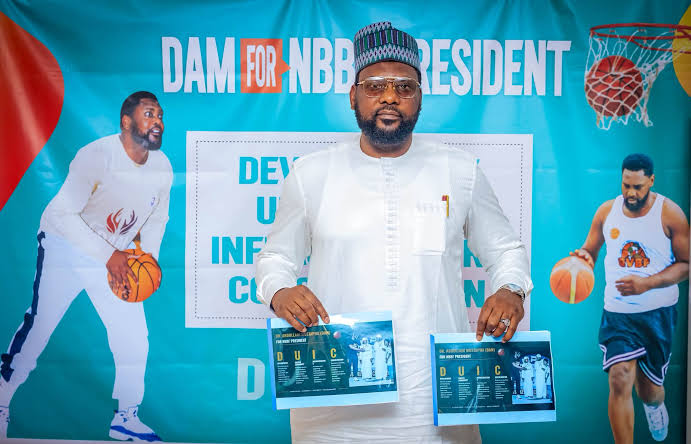
This is the context in which the candidacy of Dr. Mustapha Abdullahi, popularly known as DAM, deserves serious consideration.
His ambition to lead the NBBF is anchored in a combination of more than two decades of involvement in basketball, practical grassroots interventions, executive leadership experience and a vision for a more united, professionally administered and commercially sustainable basketball ecosystem.
Dr. Abdullahi is not approaching basketball as an outsider attracted solely by the prestige of the federation’s presidency. His relationship with the game spans years of participation, engagement with young athletes and investment in basketball development.
His playing background includes participation in Kano State basketball, the NBBF Premier League, Division One, NUGA competitions, the U-18 National Team setup and Trafford Basketball Club in Manchester, United Kingdom.
These experiences have exposed him to different dimensions of the sport, from grassroots participation and competitive basketball to the challenges athletes encounter in pursuing sporting careers.
His subsequent investments in basketball development reflect a desire to translate that experience into practical opportunities for others. Through the DAM Foundation, he has supported competitions, sporting infrastructure, youth development and interventions intended to improve access to the game.
This combination of playing experience and direct involvement in development provides an important foundation for his proposed transition from community-level interventions to national federation leadership.
A TRACK RECORD BUILT BEYOND CAMPAIGN PROMISES
One of the defining features of Dr. Abdullahi’s basketball ambition is that his involvement predates the present electoral contest.
Through the DAM Foundation, he has contributed to grassroots basketball development through several initiatives:
Basketball infrastructure in Kano: His interventions include the construction of a basketball court intended to provide young athletes with a functional space to train, compete and develop their abilities.
Sporting facilities in Okene, Kogi State: His development efforts also include a modern recreational complex in Okene, featuring a basketball court and other sporting facilities designed to expand opportunities for young people.
The annual DAM Foundation Basketball Championship: Organised in Okene, the championship provides a platform for competition, talent exposure and community participation, reflecting the importance of organised events in sustaining grassroots basketball.
An academy serving more than 500 children: Through the basketball academy associated with his foundation, young people have access to a structured environment for learning and developing their sporting abilities.
Support for grassroots and inter-tertiary competitions: His involvement has included support for grassroots tournaments and efforts to revive inter-tertiary basketball, recognising the role schools and universities can play in talent identification and development.
Youth empowerment and player welfare: His broader interventions have included support for scholarships, medical assistance, player welfare, business grants and employment facilitation, demonstrating an approach that recognises the needs of athletes beyond the basketball court.
These initiatives do not, by themselves, resolve every challenge confronting Nigerian basketball. They do, however, provide concrete examples of prior engagement that can inform his proposed national development agenda.
The central argument behind his candidacy is that initiatives currently undertaken at community and regional levels can be expanded through a coordinated federation-wide framework, with transparent priorities, measurable targets and partnerships capable of reaching more athletes.
DISTINCTIVE QUALITIES THAT SHAPE HIS CANDIDACY
1. First-hand basketball experience and grassroots commitment
Dr. Abdullahi’s involvement as a player and subsequent investment in grassroots development give him an understanding of the relationship between access to facilities, regular competition and the discovery of talent. His record through the DAM Foundation provides practical context for his proposals on schools basketball, academies, community courts and youth competitions.
2. Executive leadership and institutional management
As Director-General and Chief Executive Officer of the Energy Commission of Nigeria, he leads a federal institution and brings experience in organisational management, strategic coordination, programme implementation and stakeholder engagement. These are relevant capabilities for an NBBF administration seeking to strengthen its systems, professionalise its operations and establish measurable performance objectives.
3. Strategic thinking and a focus on sustainable development
His proposed agenda extends beyond national-team performances. It addresses the domestic leagues, infrastructure, technical development, player welfare, commercial partnerships and the institutional arrangements required to sustain progress. His proposed 100-day action plan further identifies immediate administrative priorities rather than leaving the entire programme at the level of broad aspirations.
4. Youth engagement, partnership and national inclusion
His youth-development work and public engagement complement his stated commitment to making basketball accessible across geographical and economic boundaries. His proposed approach emphasises collaboration among state associations, clubs, players, coaches, referees, academies, sponsors, former internationals and other stakeholders, with particular attention to girls and women in basketball.
Together, these qualities provide the basis for a candidacy focused on connecting experience with reform, grassroots investment with national coordination, and sporting ambition with institutional responsibility.
WHY NIGERIAN BASKETBALL NEEDS A NEW RENAISSANCE
A new renaissance in Nigerian basketball should not be understood merely as a change of personnel. It should represent a deliberate effort to strengthen the structures that make sporting success possible.
The country needs a development system in which talented children are discovered early, domestic competitions operate on predictable schedules, clubs can attract investment, athletes receive appropriate welfare support and national teams benefit from consistent preparation.
The challenge is to move from isolated interventions to a coordinated national system.
For the NBBF, this means asking difficult but necessary questions: How can grassroots talent be identified more systematically? How can domestic leagues become more regular and commercially attractive? How can the federation build stronger relationships with sponsors? How can players and technical personnel be better supported? And how can governance become more transparent, inclusive and accountable?
Dr. Abdullahi’s proposed programme addresses these questions through a series of specific reforms.
1. Rebuilding the grassroots development pipeline
His vision includes a coordinated national schools basketball programme for boys and girls, annual competitions at local government, state, zonal and national levels, regional talent-development centres and a national talent-identification and player-tracking system.
The objective is to establish a clearer pathway from schools and community courts to academies, clubs, domestic leagues and national teams.
Dedicated support for underserved and rural communities would also help widen access to the game. No talented child should have to abandon a sporting ambition simply because the facilities, coaching or competition opportunities available in their community are inadequate.
2. Revitalising domestic leagues and club basketball
A sustainable national-team programme depends on a strong domestic basketball ecosystem.
The DAM agenda proposes a predictable annual competition calendar, stronger club structures, transparent licensing, improved player contracts and welfare, better venues, digital statistics, live scoring and stronger broadcasting.
It also envisages the strengthening of developmental competitions and the men’s and women’s leagues.
Regular, well-organised competitions would give athletes more opportunities to improve, help clubs plan their activities and provide sponsors with a more dependable platform for investment.
The objective is to make Nigerian basketball more competitive on the court while improving its organisational and commercial foundations.
3. Strengthening D’Tigers, D’Tigress and the age-grade teams
Nigeria’s national teams should be supported by a system that prepares athletes consistently rather than relying predominantly on short-term arrangements ahead of major competitions.
Dr. Abdullahi’s proposals include early preparation, qualified technical crews, merit-based selection, improved medical and travel arrangements, stronger integration of home-based and overseas-based players, and long-term succession planning.
The Under-16, Under-18 and other age-grade teams would form an important part of this development pathway.
The achievements of D’Tigress also demonstrate why women’s basketball deserves sustained institutional attention. His proposed programme places women’s domestic competitions, opportunities for girls, female coaches and referees, athlete protection, dedicated sponsorship and greater media visibility among its priorities.
4. Investing in coaches, referees and technical personnel
Basketball development requires competent professionals at every level.
The proposed programme includes continuous training, certification and professional development for coaches, referees, statisticians, physiotherapists, team managers and other technical personnel.
Potential areas of focus include international exchange opportunities, mentorship, scouting, video analysis, performance analytics, sports medicine, strength and conditioning, and youth coaching.
By investing in the people responsible for training athletes, managing competitions and supporting performance, the NBBF can strengthen the quality and credibility of basketball across the country.
5. Building and maintaining functional infrastructure
The Kano and Okene projects provide practical context for Dr. Abdullahi’s emphasis on sporting infrastructure.
At the national level, his proposals include a comprehensive audit of basketball courts and indoor sports facilities, partnerships to renovate abandoned venues, support for community-court construction and the development of regional high-performance centres.
The programme also recognises the importance of maintenance, accessibility and safety. Building facilities without providing for their long-term upkeep would undermine the purpose of the investment.
The broader objective is to improve access to functional training and competition facilities across Nigeria’s six geopolitical zones.
6. Making the NBBF commercially sustainable
One of the major questions confronting modern sports administration is how to move beyond dependence on irregular funding.
Dr. Abdullahi proposes a professional commercial structure within the federation, focusing on corporate sponsorship, broadcasting and digital-media rights, merchandise, competition branding, event management, diaspora engagement and international sports-development funding.
Stronger partnerships with Nigerian businesses and multinational organisations could help expand the resources available for competitions, facilities, athlete development and technical programmes.
Such partnerships must be supported by clear agreements, transparent reporting and demonstrable value for sponsors.
The long-term objective is to develop basketball as both a competitive sport and a viable economic ecosystem capable of supporting employment in coaching, officiating, sports medicine, media, marketing, events and facility management.
7. Restoring unity, transparency and stakeholder confidence
The NBBF serves a broad basketball community, and its administration must provide meaningful channels for participation and consultation.
The proposed reforms include reconciliation among stakeholders, stronger communication with state associations, transparent financial and operational reporting, digital registration and licensing, measurable departmental targets, and advisory structures for players, coaches, referees and clubs.
The programme also calls for merit-based selection and appointments, stronger dispute-resolution processes and compliance with the NBBF Constitution, FIBA requirements and relevant national regulations.
The principle is straightforward: the federation should operate as an institution serving the wider basketball community, rather than as a platform for narrow interests.
8. Making basketball an instrument of youth empowerment
For Dr. Abdullahi, basketball has significance beyond competition.
His proposed agenda recognises its potential to provide constructive opportunities for young people, support education, promote discipline, create livelihoods and strengthen relationships across communities.
The programme also envisages career guidance, financial literacy, scholarship opportunities, support for athletes transitioning into coaching and administration, and greater inclusion for persons with disabilities through initiatives such as wheelchair basketball.
This approach connects sports development with wider social and economic objectives. A functioning basketball system can create opportunities not only for professional players, but also for young people seeking careers across the sporting industry.
A PRACTICAL STARTING POINT: THE PROPOSED FIRST 100 DAYS
A key feature of Dr. Abdullahi’s proposition is the identification of immediate steps through which the proposed administration would begin its work.
His proposed 100-day action plan includes:
A comprehensive audit of the federation’s finances, competitions, facilities and development programmes.
A national basketball stakeholders’ summit.
The publication of a unified annual competition calendar.
The establishment of advisory structures for players, coaches, referees and clubs.
The commencement of a national digital registration and statistics platform.
Engagement with existing and prospective sponsors.
A national audit of basketball facilities and major local competitions.
A reconciliation programme for recognised basketball stakeholders.
A technical review of the men’s, women’s and age-grade national teams.
The publication of a four-year strategic development and performance plan.
These proposals provide a framework against which the basketball community could assess progress if he is elected. Their impact would ultimately depend on implementation, available resources, stakeholder cooperation and regular reporting.
EXPERIENCE BEYOND THE COURT
Dr. Abdullahi’s experience as head of the Energy Commission of Nigeria adds an institutional dimension to his candidacy.
Leading a federal agency involves coordinating people, programmes and partnerships within an established administrative framework. Applied appropriately to sports governance, such experience can inform the development of clearer procedures, performance targets, accountability mechanisms and long-term plans.
His public engagement in youth development and sports mobilisation also reflects an interest in connecting sports with broader opportunities for young Nigerians.
However, the presidency of the NBBF requires its own specialised focus. The task would be to apply relevant executive experience while working closely with basketball professionals, clubs, state associations, technical personnel and athletes who understand the operational realities of the game.
His proposed emphasis on consultation and advisory structures acknowledges the importance of that collective expertise.
THE BIGGER OPPORTUNITY FOR NIGERIAN BASKETBALL
The ambition to lead the NBBF comes at a time when sports development is increasingly discussed in terms of economic opportunity, private-sector investment and employment creation.
Basketball has the potential to contribute to this wider sports economy, but that potential must be supported by reliable competitions, professionally managed clubs, modern facilities, strong technical development and effective commercial partnerships.
Nigeria’s next generation of players is already emerging in schools, universities, academies and neighbourhood courts. The question is whether the institutions responsible for the game can provide the structure, coaching, competition and support required to help those young athletes progress.
The same question applies to coaches seeking professional development, referees seeking certification, clubs seeking predictable competitions and former athletes seeking opportunities to contribute to the game.
A more coordinated NBBF could help connect these interests within a common development framework.
Dr. Abdullahi’s candidacy presents a proposal to pursue that direction by building on existing grassroots interventions while placing greater emphasis on professional administration, national coordination, sustainable funding and stakeholder inclusion.
THE CHOICE BEFORE THE BASKETBALL COMMUNITY
The October 15 elective congress provides delegates with an opportunity to examine the candidates’ records, proposals, leadership experience and commitments to the future of Nigerian basketball.
The issues deserve careful consideration: the strength of the grassroots pipeline, the regularity and quality of domestic competitions, the welfare of athletes, the sustainability of national teams, the development of women’s basketball, the state of infrastructure, commercial viability and the credibility of federation governance.
Dr. Mustapha Abdullahi’s proposition brings these issues together within a programme that seeks to connect practical grassroots investment with wider institutional reform.
His record through the DAM Foundation, his experience in basketball and his public-sector leadership provide the background to his ambition. His proposed development agenda sets out the areas in which he intends to pursue change if entrusted with the responsibility.
The task ahead will require more than one individual. It will demand cooperation, disciplined administration, dependable financing, professional expertise and the willingness of stakeholders to work towards shared objectives.
The value of any NBBF administration must be measured by what it delivers: stronger competitions, better opportunities for athletes, functional facilities, improved welfare, transparent governance and a sustainable pathway for the next generation.
Dr. Mustapha Abdullahi’s message is built around a simple proposition: Nigerian basketball must move from untapped potential towards a system capable of delivering sustained progress.
From grassroots investment to national development. From fragmented opportunities to structured pathways.From administrative uncertainty to accountable systems. From talent discovery to professional opportunity.
From potential to podium.
DAM FOR NBBF PRESIDENT 2026
Arise NBBF!
Related posts:
- NBBF Presidency: Dr. Mustapha Abdullahi and the Making of a New Dawn, By Sunny Ibeh Jnr
- Time for a New Playbook: Why Dr. Mustapha Abdullahi Should Lead the NBBF, By Etudaiye Suleiman Hassan
- The Business of the Game: Why Dr. Mustapha Abdullahi Is My Choice to Lead Nigerian Basketball, By Ugo Udezue
- JUST IN: Dr. Mustapha Abdullahi Set To Declare For NBBF Presidency
