
Share!
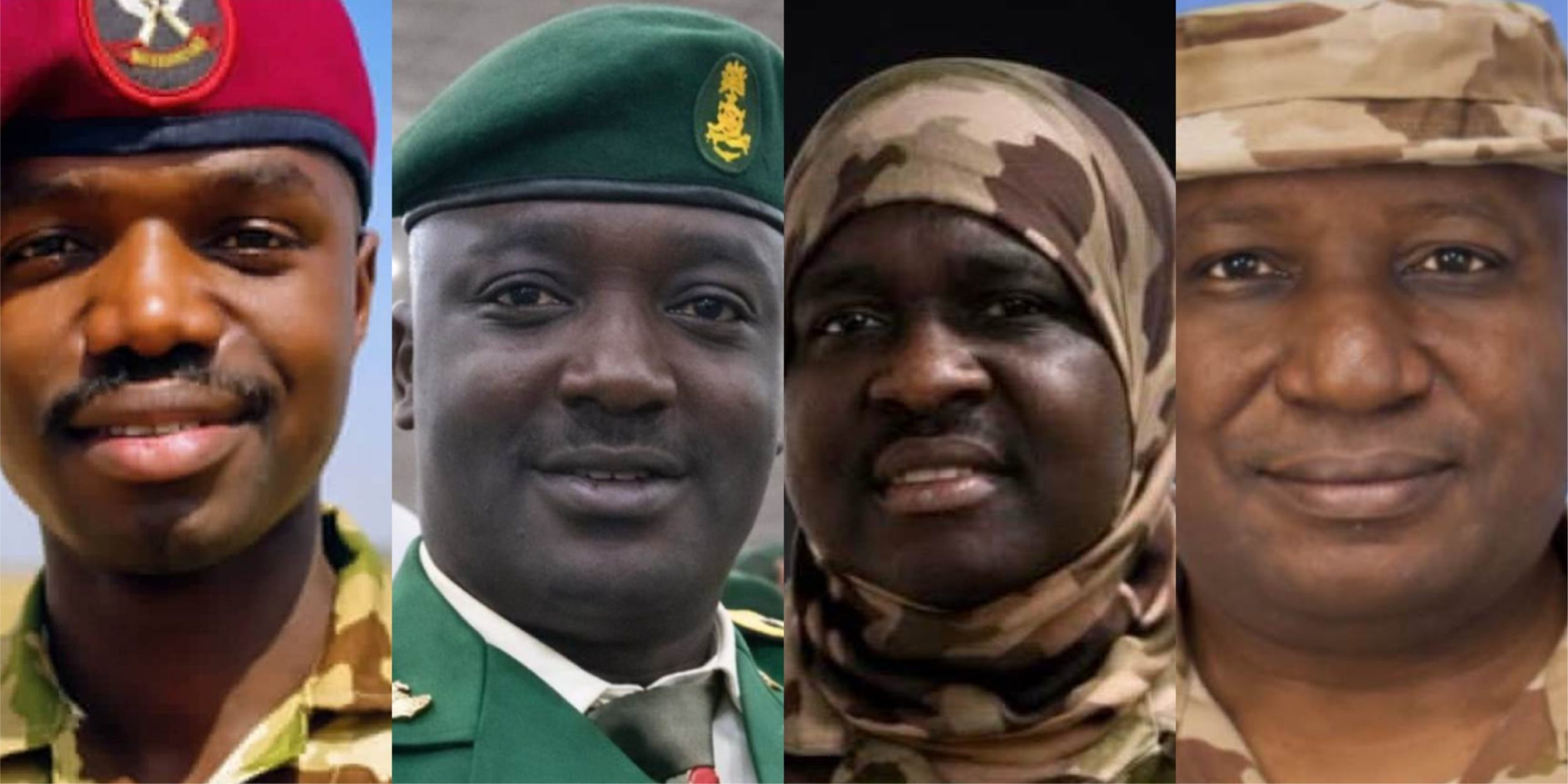
Meet Top Army Commanders, Terrorists Killed in Borno Recently
*By Kabir Abdulsalam,*
Between January and March 2026, Nigeria’s counterinsurgency campaign in the North-East entered a phase defined less by territorial control and more by leadership attrition.
Under Operation Hadin Kai, the battlefield has increasingly become a contest of command structures, where both the Nigerian military and insurgent groups deliberately target high-value individuals to gain tactical advantage.
Within this period, the Nigerian military recorded the loss of several commanding officers in separate but related attacks across Borno State, each attracting deliberate targeting of leadership.
One of the most significant was Lt.-Col. Umar Faruq, Commanding Officer of the Kukawa base under the 101 Brigade. He was killed on March 9, 2026, when Boko Haram/ISWAP fighters launched a coordinated night assault on the military formation in Kukawa.
According to field accounts, the attack began around midnight, with insurgents advancing from multiple directions, overwhelming defensive positions and dislodging troops. Military vehicles were destroyed and weapons looted.
Lt.-Col. Faruq, who had earlier repelled a similar attack weeks before, was killed during the defence of the base. His loss created a temporary operational gap in the Kukawa axis, a critical zone within the Lake Chad Basin.
Three days earlier, on March 6, Lt.-Col. S.I. Iliyasu, Commanding Officer of the 222 Battalion in Konduga, was killed during another insurgent attack. The engagement, involving elements of the 21 Special Armoured Brigade, resulted in multiple casualties, including junior officers.
The attack is assessed to have targeted a key command node within the Konduga–Maiduguri corridor, an operation vital to the protection of the state capital.
Similarly, on March 1, Major Umar Ibrahim Mairiga, who commanded a forward operations base in Mayenti, Bama Local Government Area, was killed during a sustained assault on his position. Recently deployed following a promotion, Mairiga led troops stationed in one of the most exposed forward locations. Insurgents employed heavy weapons, including rocket-propelled grenades and anti-aircraft systems, indicating significant firepower.
Despite resistance, the base was eventually overrun after elements of the defending unit became fragmented. Mairiga was killed in action, having inflicted casualties on the attacking force.
Earlier in January, Lt.-Col. Mohammed was killed alongside six soldiers during an ISWAP ambush near Damasak. The commanding officer, according to news reports, was recently promoted from the rank of major to lieutenant colonel.
Their patrol unit was intercepted, and the officer was reportedly killed in an attack that highlights insurgent capability in surveillance and ambush operations against mobile military elements.
Taken together, these incidents point to a clear tactical shift. Insurgent groups are increasingly focusing on eliminating commanding officers to disrupt coordination, weaken morale, and create exploitable vulnerabilities within military formations.
At the same time, the Nigerian military has intensified its own campaign of leadership targeting against insurgent groups, with notable results recorded in March 2026 around Malam Fatori in Abadam Local Government Area.
In one of the most significant engagements, Mallam Abdulrahman Gobara, identified as a senior ISWAP commander, was killed on March 18 during a failed infiltration attempt on military positions.
He was neutralised alongside Mallam Ba Yuram and Abou Ayyuba, both regarded as key figures in coordinating attacks within the Lake Chad axis. The trio were intercepted during an attempted breach and eliminated through coordinated ground and aerial response.
Also killed in the same operational cycle were Amir Abu Aisha, also known as Nagif, and Amir Abu Ali Chaptar, nicknamed “Gunner Sambisa.” Both were high-ranking commanders within ISWAP, with responsibilities linked to tactical assault planning and weapons coordination. At least one of the operation involved a decoy ambush, suggesting an increasing use of deception tactics by the military to draw out and eliminate high-value targets.
In Yobe State, Abu Yusu, identified as a Munzir within the insurgent hierarchy, was killed during a foiled attack on a military base in Goniri. Similarly, Malam Jidda, described as the Ameer of Ngorgore and Malumti villages within the Timbuktu Triangle, was neutralised during a separate engagement with troops.
A broader offensive in the Malam Fatori axis, supported by precision air strikes from the Nigerian Air Force and coordinated ground assaults, resulted in the elimination of over 80 insurgents, including experienced fighters and emerging commanders.
These operations targeted assembly and supply routes, significantly degrading insurgent operational capacity in the location.
A key reference point in the military’s leadership targeting strategy remains the elimination of Amir Abu Fatima in May 2025. The high-value target was tracked to Aleru village in Kukawa Local Government Area, where Special Forces of the 19 Brigade, working with the Multinational Joint Task Force and Civilian Joint Task Force, executed a precision strike.
He was critically wounded during the firefight, captured, and later died from excessive bleeding. With a ₦100 million bounty on his head, Abu Fatima was regarded as a major operational commander responsible for attacks across the Lake Chad Basin.
The pattern that emerges from these developments is one of strategic symmetry. While insurgents have demonstrated growing capability in targeting military leadership through ambushes and base overruns, the Nigerian military is simultaneously executing structured decapitation operations aimed at dismantling insurgent command hierarchies.
This reflects an evolution in the conflict—from a focus on territorial dominance to a contest of organisational resilience.
In this environment, the removal of commanders on either side has immediate tactical implications and longer-term strategic consequences which suggests that the war is increasingly defined by the systematic targeting of those who lead.
No related posts.
