
Share!
Over the years, there have been assessments of organisational practices, analyses of policy entrenchment processes and civil culture across nations’ internal affairs and even geopolitics. MNI Versus MNIPR in NIPSS is a compendium of truth churned out with quintessential creativity that finds expression as fine prose dissecting an issue of critical concern: bullying and protracted injustice. The author, Yushau A. Shuaib, is an industry leader, a mentor in the PR and strategic communication ecosystem, and one of the finest Nigeria and Africa have produced in decades.
I have known the author for a good number of years and counting. As a matter of fact, I became a distant mentee even before meeting him physically for the first time. I had been following his savoury insights, learning from his uncommon writing prowess and learning from his success story as the founder and lead consultant of one of Africa’s thriving crisis communication firms, Image Merchant Promotions (IMPR), publishers of PR Nigeria, Spokesperson Digest and Economic Confidential.
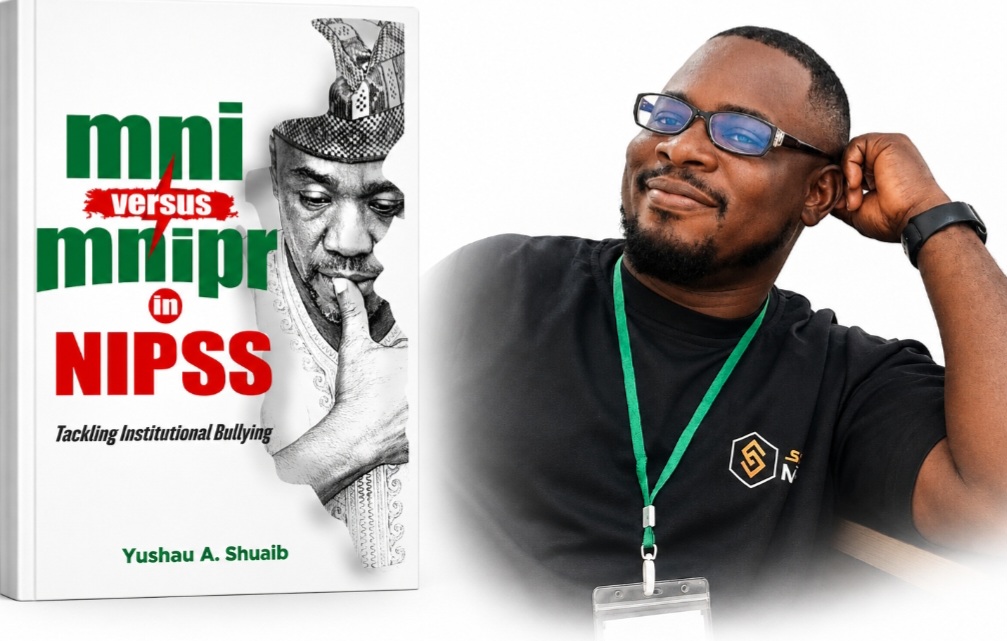
The news of his unjust suspension from the National Institute for Policy and Strategic Studies (NIPSS) came as a shock. I was surprised and dumbfounded. What could be the reason? I asked rhetorically while I was submerged in thoughts and a pool of mixed feelings. But when I got a copy of MNI Versus MNIPR in NIPSS: Tackling Institutional Bullying, it became very lucid to me that his travails had more than met the eye. Progressing from one page to the next came with a vivid and candid narration that did justice to my curiosity as a media and communications practitioner.
My review of the masterpiece is precipitated only by sincerity and my knowledge as a critic who has always wanted the best for Nigeria, with close to two decades of protest and agitation in the armchairs of intellectualism, using writing and strategic communication as a vehicle of conveyance to drive home the truth and nothing but the truth. Although I have been aware of the existence of NIPSS, as a matter of fact, I penned it down in a master’s admission essay in faraway Sweden for the Swedish Institute Scholarship. I described the Institute as one of the places where I would love to democratise my knowledge after my studies in Sweden, should I get admitted. The above, coupled with the author’s profound and qualitative style of narration, literally transported my mind down to Kuru in real time.
From Chapter One, “The Summons to Kuru,” the author gave an explicit narration of how the journey to NIPSS began. He left no stone unturned, putting out in detail facts that characterised the journey, which came as an unplanned policy and strategic voyage. He described the immediate environment upon getting to Kuru and his preliminary experience, which created mental pictures of his real-time experience at Nigeria’s apex institute for policy and strategic studies. In each of the other chapters, the author made his narration quite explicit and simple for cognitive consumption. For example, Chapter Two, “Arrival into Discipline,” speaks volumes about the level of discipline at NIPSS and also reaffirmed the author’s willingness and commitment to discipline, regardless of his status and position in Nigerian society.
Chapter Five , on the other hand, comes off as another special chapter for me. The author took us down memory lane, telling the story of his career, beginning from his days in Kano, where he was raised by his disciplinarian father, Imam Abduhameed Shuaib Agaka, an erudite Islamic scholar of repute, who prepared him for the task ahead. It was a preparation that shaped his career years subsequently at the Ministries of Finance and Health, the Revenue Mobilisation, Allocation and Fiscal Commission, and as head of Public Relations at the National Emergency Management Agency (NEMA), as well as his subsequent career crisis in 2013. As a young journalist and communication and public relations professional, the author’s career experiences constitute a repository of lessons for me.
The Experience of Bullying at NIPSS
According to the Oxford Advanced Learner’s Dictionary, 10th Edition, bullying is the use of strength or power to frighten or hurt weaker people. In simple terms, bullying involves using one’s strength, authority or power to intimidate, frighten or hurt someone perceived as weaker. I do not know the author to be weak in any way. As a matter of fact, he is a dogged fighter who maintains equanimity even in the face of provocation. Considerably, he balances things courteously between his status as a renowned and accomplished PR authority and his relationships with people in society. Hence, his unassuming personality, woven in candour and humility. It is therefore surprising that he would be treated in a condescending manner by officers at NIPSS, as he narrated in a chapter of this work.
Everywhere in the world, the standard best practice for media houses is the principle of independence, which prevents encroachment by publishers who own these media outfits and interference in their editorial operations. What this means is that reports or stories can be produced and published without seeking permission or notifying the owner, especially if they are not part of the editorial teams.
Consequently, the PR Nigeria case should not be treated as an isolated case. I own The MeridianSpy, a digital newspaper, published by Shevlux Media & PR Limited.
But in 2020, I was out of its editorial team. I had to face other pressing engagements. The medium was independently run by an editorial team without my interference until I returned as the editor-in-chief a few years back. So, I understand it when the author narrated his non-involvement in the report about NIPSS published on the PR Nigeria platform.
Rear Admiral A. A. Mustapha, who interrogated him at the first instance, clearly lacked editorial knowledge of journalistic standard best practices. This explains why he erred in his interpretation and submissions of the incident, handling it poorly with impudence and repulsion. In my view, his approach was a startling display of ignorance decorated in military attire. Personally, I do not understand why the story titled “NIPSS Goes Digital: Launches Paperless Platform After Submitting Landmark Report to President Tinubu,” published on March 19, 2025, would rattle the Institute. I mean, it was a report that was repositioning in nature. Moreso, why was a detailed response to a query rejected in an arbitrary display of power? What happened that the second written clarification made no difference?
Indeed, I agree with the author that his experience was institutional bullying disguised as discipline. I am more compelled to believe the writer’s narration because, in Nigeria, the abuse of power and position has transcended the point of becoming a norm and has been accepted as a societal culture. It is seen in almost every establishment, especially public establishments, and is sustained by another culture of ours known as impunity.
I find the author’s experience at NIPSS extremely troubling, considering the trajectory of injustice he faced and the series of queries and summons that ordinarily should not have occurred. It represents the troubling state of our institutional decadence in Nigeria and the subsaharan African region. I commend the author’s insistence on dignity, conscience and doing what is right in the face of organized oppression.
Institutional Accountability and the Pursuit of Justice
The Nigerian Institute of Public Relations (NIPR) intervention, which began with the president, Dr Ike Neliaku, was very commendable. However, after the suspension, the summons by the council, as the author narrated, I think, could have been handled in a better way than it was. To me, it came across as a complementary or supporting approach to what had happened at Kuru, which the author described as “institutional bullying.” So, I believe NIPR could have handled the post-suspension issue better, especially considering the commendable way it initially handled the matter by following up on the issue and speaking with the author at the preliminary stage of the crisis and dispute.
I say so in view of the fact that the author has been a member of the NIPR since 1995 and has contributed tremendously to the advancement, sustenance and repositioning of the institute across different administrations. I therefore believe he deserves a certain level of dignity and respect beyond what he was given.
A Stance Against Institutional Bullying and Oppression
In reviewing this book and giving my assessment of the subject matter, I am emboldened by the thoughtful words of Elie Wiesel, the Jewish-American writer, during his Nobel Peace Prize acceptance speech at Oslo City Hall in Oslo, Norway, on 10 December 1986. On that day, he said, “We must always take sides. Neutrality helps the oppressor, never the victim.”
Elie Wiesel was a Holocaust survivor, professor and human rights activist. He survived Nazi concentration camps during the Second World War, where his mother, father and younger sister perished. The author, Yushau Shuaib, shared similar fate with Elie Wiesel given the institutional bullying he faced at Kuru.
I will never support an oppressor, directly or indirectly. The day I support an oppressor will be the day I cease to breathe. I therefore stand firmly in solidarity with the author because I firmly believe the author was a victim of a repugnant system, with institutional oppression littered like tattered rags across a plethora of establishments.
As an ex-student leader who fought systems and the obnoxiousness of university managements, I understand clearly what the author went through. In my days as an elected executive of the National Association of Nigerian Students (NANS), we intransigently resisted the oppressive tendencies and actions of university managements and governments. We fought anti-student policies and waged wars against entrenched abuses of power. With this background, I could relate to the ordeal of the author as narrated in the book.
In general, my review of the book MNI Versus MNIPR in NIPSS: Tackling Institutional Bullying, by Yushua Shuaib is a detailed expression of institutional misnomer in the Nigerian society, which we must all confront. I extol his resolve to take legal action and his further resolve to appeal the dismissal of his initial case at the Federal High Court by Justice Binta Nyako. This shows a man who knows what he wants, a fighter who is a prisoner of conscience, while believing that justice delayed can never be justice denied.
The book, in a nutshell, is a revelation of the troubling experiences Nigerians go through in different establishments across the country. It gives credence to the fact that power and authority are mostly abused in Nigeria and, painfully, that they are abused without consequences. I strongly recommend the book to all those who have been victims of unjust and unfair treatments. Professionals, especially in the communication, journalism and publishing industries, should therefore brace up for possible occurrences that might arise along their career journey.
Final Thoughts and Submissions
Renowned clergyman and human rights activist Desmond Tutu, in his words condemning oppression, said, “If you are neutral in situations of injustice, you have chosen the side of the oppressor.” Like Elie Wiesel, Desmond Tutu, gives us reason anew to firmly with victims against the oppressor.
As a young journalist, communication and Public Relations professional, this work exposes me to what I may expect as I journey along the pathways of my career, and to what may happen as I live and practise journalism, communication and public relations in Nigeria. It also exposes me to the legal bottlenecks I might face as a possible victim of oppression and unfair treatment in Nigeria. It is on this premise that I say this work is a child of necessity, which I think, among other things, speak against institutional bullying and injustice in general. Finally, I commend the author for such a detailed, sincere, revealing work. It is indeed a privilege to review this book by the public relations maestro and veteran himself , Yushau A. Shuaib. In solidarity, I stand with him now and always.
Related posts:
- Dr. Uchechukwu Sampson Ogah @56: A Sincere Reflection Beyond Words, By Sunny Ibeh Jnr, anipr
- Atiku’s New Campaign Rhetoric: The Power of Strategic Communication in Politics, By Sunny Ibeh Jnr
- NBBF Presidency: Dr. Mustapha Abdullahi and the Making of a New Dawn, By Sunny Ibeh Jnr
- Otti Targets Seven Sectors to Attract Investment Capital to Abia
