
Share!
ANALYSIS: Press Freedom, Power and Nigeria’s Battle for Truth By Kabir Abdulsalam
Yesterday, I followed proceedings marking World Press Freedom Day, where the Minister of Information and National Orientation, Mohammed Idris, addressed stakeholders on the state of the media in Nigeria. He reiterated that the current administration is committed to collaboration with media organisations and international partners to promote responsible journalism and counter misinformation.
His position that government communication should be anchored on transparency, access to information, and sustained engagement has been consistent. Through the Freedom of Information framework and expanded public communication channels, the federal government has, at least at the centre, tried to maintain that line.
Meanwhile, at the subnational level, tensions between government authorities and the media have become increasingly visible. In Niger State, Governor Umar Bago has repeatedly drawn criticism for his stance on this issue. A key example occurred when he ordered the closure of a private radio station over an interview aired in August last year. The directive—which reportedly included revoking the station’s license and profiling its owner—was widely condemned by rights groups as an excessive abuse of power.
Across several states between 2023 and 2026, reports of pressure on journalists and media organisations have continued to surface. The 2024 Openness Index by the Centre for Journalism Innovation and Development found that 22 out of Nigeria’s 36 states showed tendencies that restrict press freedom. In Imo State, authorities have faced accusations of attempting to influence media structures, while in Delta and Ebonyi, arrests and detentions of journalists have been documented — often with security agencies drawn into disputes many believe could have remained civil matters.
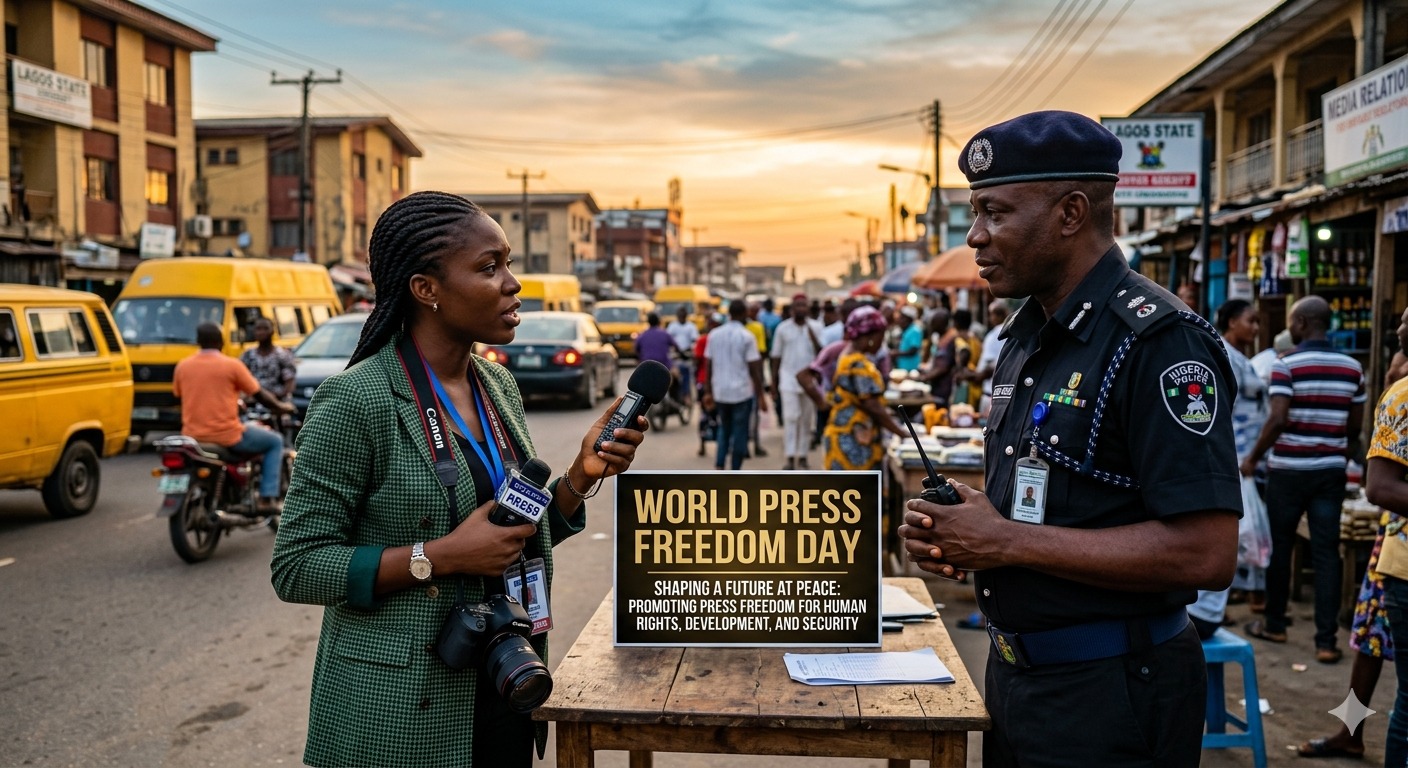
This year’s World Press Freedom Day—themed “Shaping a Future at Peace: Promoting Press Freedom for Human Rights, Development, and Security”—arrives at a time when the balance between freedom and control feels increasingly delicate. The global message underscores that a free and independent media is central to democratic stability. Yet, in environments shaped by security challenges and political pressures, the question extends beyond freedom itself to how that freedom is exercised and managed.
The strain of this environment is clearly illustrated by recent data from the International Press Centre. In 2025 alone, at least 23 incidents involving 28 journalists and two media organizations were recorded, ranging from harassment and intimidation to unlawful arrests and physical assault. Notably, the online media space accounted for the highest number of cases—a stark reflection of both its growing reach and its heightened exposure to risk.
Globally, the trend is even more concerning. The United Nations estimates that 85 percent of crimes against journalists go unpunished—a level of impunity that Secretary-General António Guterres has described as unacceptable. Where accountability is weak, pressure on the press tends to intensify.
Nigeria reflects these tensions, though in ways shaped by its own internal realities. In recent months, friction between the media, security agencies, and regulators has become more pronounced. Security institutions, in particular, have shown heightened sensitivity to narratives surrounding their operations. The recent arrest of a content creator over claims of poor feeding within the military—allegations the army dismissed as false—exemplifies this unease. For the military, such claims risk undermining morale and operational confidence; for critics, however, the response raises concerns about a shrinking space for public scrutiny.
This year’s World Press Freedom Day—themed “Shaping a Future at Peace: Promoting Press Freedom for Human Rights, Development, and Security”—arrives at a time when the balance between freedom and control feels increasingly delicate. The global message underscores that a free and independent media is central to democratic stability. Yet, in environments shaped by security challenges and political pressures, the question extends beyond freedom itself to how that freedom is exercised and managed.
Recent data from the International Press Centre clearly illustrates the strain this environment places. In 2025 alone, at least 23 incidents involving 28 journalists and two media organizations were recorded, ranging from harassment and intimidation to unlawful arrests and physical assault. Notably, the online media space accounted for the highest number of cases—a stark reflection of both its growing reach and its heightened exposure to risk.
Globally, the trend is even more concerning. The United Nations estimates that 85 percent of crimes against journalists go unpunished—a level of impunity that Secretary-General António Guterres has described as unacceptable. Where accountability is weak, pressure on the press tends to intensify. Nigeria reflects these tensions, though in ways shaped by its own internal realities.
In recent months, friction between the media, security agencies, and regulators has become more pronounced. Security institutions, in particular, have shown heightened sensitivity to narratives surrounding their operations. The recent arrest of a content creator over claims of poor feeding within the military—allegations the army dismissed as false—exemplifies this unease. For the military, such claims risk undermining morale and operational confidence; for critics, however, the response raises concerns about a shrinking space for public scrutiny.
The legal arena presents a similar tension. The ongoing trial of activist Omoyele Sowore over allegations linked to cyberstalking and defamation—following his social media comments about President Bola Ahmed Tinubu—highlights how quickly political expression can intersect with criminal law. Together, these cases reinforce a growing perception that responses to information, particularly in the digital space, are becoming increasingly securitized.
The National Broadcasting Commission has raised concerns about what it describes as a “crisis of anchor and presenter professionalism.” It points to a pattern where broadcasters inject personal opinions, fail to ensure balance, and allow inflammatory narratives to shape discussions. For many observers, this reflects a broader shift in the media landscape—one where the line between reporting and commentary is becoming increasingly blurred.
In some instances, interviews are less about extracting information and more about advancing positions. The moderator becomes a participant, and the conversation tilts toward confrontation. This shift carries serious implications for credibility; when objectivity is diluted, trust becomes harder to sustain.
There are also concerns about how security issues are reported. Coverage of military operations—including incidents such as the Jilji market episode—has at times been framed in ways that amplify fear rather than clarify facts. In a country already navigating complex security challenges, such framing can deepen anxiety and distort public understanding.
Beyond mainstream journalism, the rise of citizen media has further complicated the landscape. Social media has expanded access to information, giving individuals unprecedented influence over public narratives. But that expansion has come without the editorial discipline that defines professional journalism. Verification is often inconsistent, context is frequently missing, and unverified claims are presented as established facts.
Recent incidents underscore this risk. The arrest of content creators following the circulation of claims involving businessman Tony Elumelu illustrates the legal risks of digital publishing. The consequence is a fast-moving information environment where narratives take hold before verification, and perception often precedes fact. Institutions are pushed to react quickly, sometimes without full clarity, while the public forms opinions in real time.
This is where the central tension lies.
For government and security agencies, concerns about misinformation are legitimate. False narratives can trigger panic, undermine operations, and distort public understanding. In such a context, the instinct to manage information is understandable. However, the method of response is critical. When responses tilt toward arrests and suppression, they risk eroding trust rather than reinforcing it. Information gaps rarely remain empty; they are quickly filled by speculation.
For the media, the obligation is equally clear. Freedom does not eliminate the need for discipline. Verification, balance, and professional conduct are not constraints—they are the pillars that sustain credibility. Without them, journalism risks blending into the noise it is meant to filter.
There is also a growing argument that the digital information space cannot remain entirely consequence-free. The speed at which unverified claims circulate means that false narratives can shape public perception within hours, sometimes causing lasting damage to reputations and institutions. This raises a necessary question: should there be clearer accountability for what is published online?
Regulation, in this sense, is less about control and more about responsibility. It suggests a framework where individuals who deliberately spread harmful falsehoods can be held accountable within the law. Without such consequences, the information ecosystem risks becoming one where accuracy is optional and credibility is secondary.
At the same time, any approach must be carefully calibrated. Overreach carries its own risks—stifling legitimate expression and weakening the very freedoms it seeks to protect. The challenge, therefore, is to define boundaries that safeguard both truth and freedom without tipping too far in either direction.
Ultimately, Nigeria’s challenge is not simply about whether the press is free or constrained. It is about building a system where information—whether from government, media, or citizens—is handled with a shared sense of responsibility. Because in a country where everyone now has the power to publish, the real test is no longer access to information. It is what we choose to do with it.
kabir Abdulsalam is a public affiars analysis, writes from Abuja, can be reached via: kbabdulsalam03@gmail.com
No related posts.
